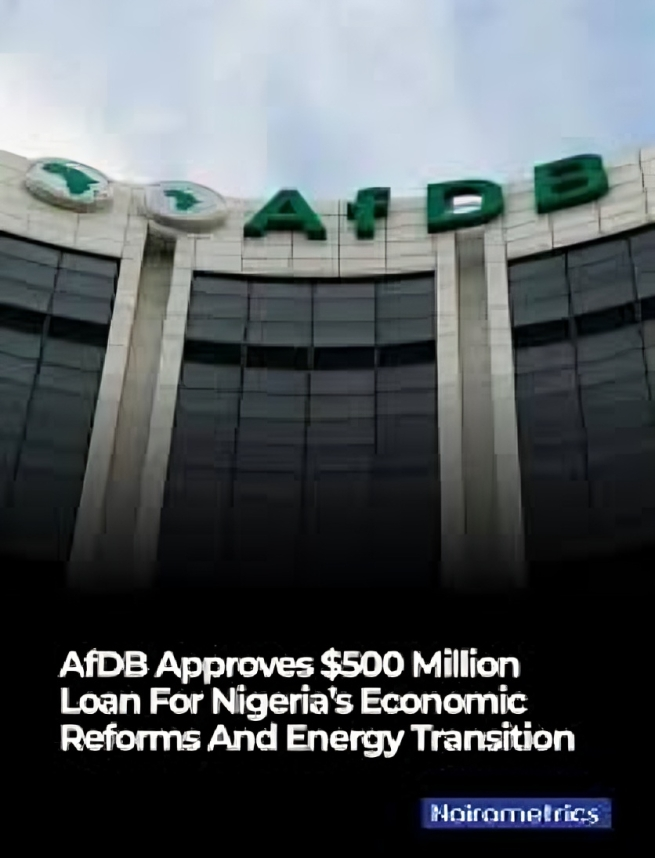
The African Development Bank Group has granted a five-hundred-million-dollar loan to the Federal Government of Nigeria to fund the second phase of the Economic Governance and Energy Transition Support Programme. The approval, which followed a Board of Directors meeting in Abidjan, is aimed at reinforcing fiscal reforms and fast-tracking Nigeria’s shift toward a more resilient and sustainable energy landscape.
The Bank stated that this policy-based operation will span the 2024 and 2025 fiscal years and is structured to drive inclusive growth by deepening essential structural reforms. This second phase builds on earlier achievements that helped stabilise fiscal systems and introduced key changes within the energy sector. According to the AfDB, the intervention will enhance public financial management, raise transparency in government expenditure, and back efforts to broaden Nigeria’s non-oil revenue base. These reforms are expected to minimise fiscal vulnerabilities and create larger fiscal room for development-oriented investments.
The facility will equally fuel major reforms in the power sector, where persistent issues—including inadequate generation, weak transmission infrastructure and governance shortcomings—continue to slow national progress. The programme seeks to expand power access, strengthen sector governance, and stimulate private sector participation across the electricity value chain. The Bank noted that delivering reliable power remains crucial to reducing energy poverty and improving the business environment, especially for MSMEs that rely on steady electricity supply to grow.
Beyond fiscal and power sector improvements, the facility will advance Nigeria’s broader energy transition targets. This includes supporting the rollout of the National Energy Transition Plan, promoting climate-resilience and mitigation strategies, updating national climate commitments for the 2026–2030 period, and enhancing energy-efficiency standards for household and industrial appliances. These actions are intended to align Nigeria with global climate ambitions while boosting domestic energy stability.
Enjoying this article? Share it with your network!
Key beneficiaries of the programme include major economic and energy institutions—such as the ministries of finance, power and environment, the tax authority, debt office, electricity regulator and national climate council. The AfDB also highlighted that the reforms will benefit private enterprises nationwide by improving the investment climate and expanding opportunities for public–private partnerships, particularly across the states.
The Bank further noted that the loan will offer critical budget support to enable the government to implement the reforms while easing near-term fiscal constraints. It stressed that fiscal consolidation, economic stability and energy security remain vital to Nigeria’s recovery efforts and crucial for rebuilding investor confidence. The intervention is projected to attract long-term capital for infrastructure development and clean energy projects, ultimately boosting productivity and resilience across the private sector.
By the end of October 2025, the AfDB maintained an active portfolio of fifty-two projects in Nigeria, valued at more than five billion dollars, covering infrastructure, agriculture, governance, energy and private sector development.