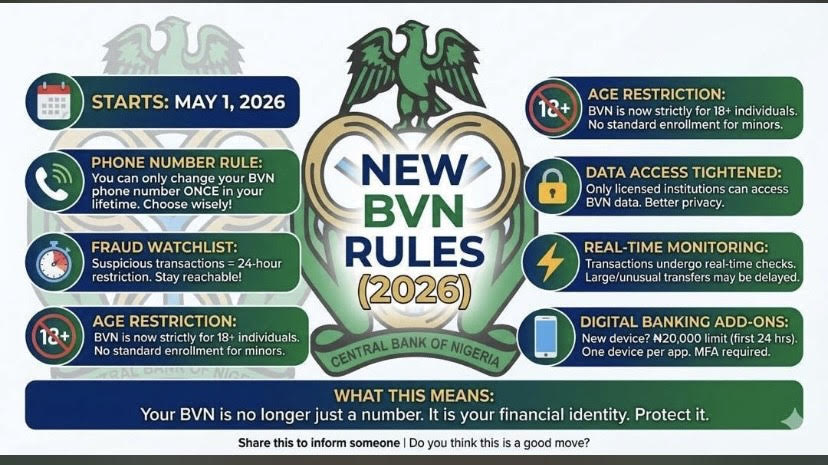
The Central Bank of Nigeria (CBN) has announced new regulations governing the Bank Verification Number (BVN) system, scheduled to begin on May 1, 2026. The revised framework is designed to strengthen financial identity management, reduce fraud risks, and improve overall security within Nigeria’s banking sector.
Under the new policy, the BVN will become more tightly regulated as a central financial identity for all users within the banking system. The updated framework introduces several operational and security changes that will affect individuals, businesses, and financial institutions.
One of the key changes is the restriction of BVN enrollment to individuals aged 18 and above. This policy effectively excludes minors from standard BVN registration and reinforces stricter participation requirements within the formal financial system.
The CBN also introduced tighter controls over BVN data access. Only licensed financial institutions will be permitted to access BVN information, a move aimed at improving data privacy and reducing the risk of unauthorized use or exposure of personal financial data.
Another major update is the limitation placed on phone number changes linked to BVN records. Account holders will only be allowed a single lifetime update of their registered phone number. The regulator stated that this measure is intended to curb identity fraud and reduce manipulation of banking records.
Enjoying this article? Share it with your network!
To further strengthen fraud prevention, the CBN is introducing a fraud watchlist system. Accounts flagged for suspicious activity may be temporarily restricted for up to 24 hours while additional verification checks are conducted. This is expected to improve response time to potential fraud cases and enhance account security.
The new framework also includes enhanced real-time transaction monitoring. Financial institutions will be required to closely scrutinize large or unusual transactions, with some payments subject to delays for verification. While this may affect transaction speed, it is expected to improve system integrity and reduce fraudulent activity.
In addition, stricter controls will apply to digital banking access. Users registering new devices for mobile or online banking may face initial transaction limits within the first 24 hours. Multi-factor authentication will also become mandatory for added security.
The implications of these changes are expected to be significant for both individuals and businesses. While users may experience tighter verification processes and occasional delays, the measures are designed to improve trust in Nigeria’s digital financial ecosystem and reduce exposure to fraud.
Disclaimer
Edfrica shares opportunities for informational purposes only. Results and funding outcomes are not guaranteed.