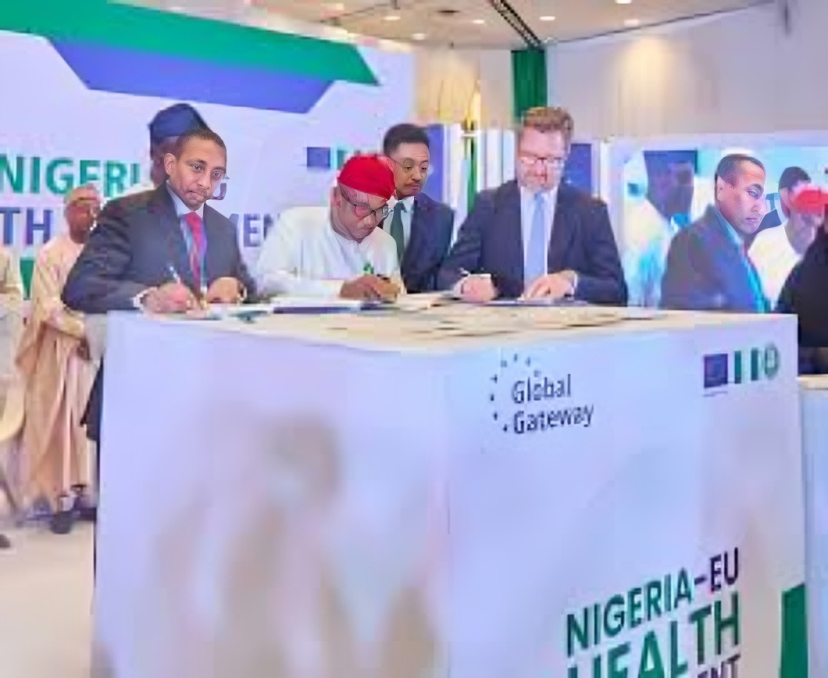
The European Union (EU) and France have announced a joint investment of €10.2 million aimed at boosting Nigeria’s pharmaceutical manufacturing sector, marking a significant move toward achieving health sovereignty and driving industrial transformation in the country.
The funding, introduced under the Global Gateway’s Manufacturing and Access to Vaccines, Medicines and Health Technologies (MAV+) Initiative, will support the Quality Uplift for Advancing Local Industry in Medicine Standards (Qualimeds Nigeria) project — a 44-month programme focused on modernising pharmaceutical production, enhancing the quality of locally made medicines, and improving access to essential medical technologies.
As outlined in the agreement signed in Abuja, the EU will provide €10 million, while the French Ministry for Europe and Foreign Affairs will contribute an additional €200,000 in co-financing.
The project, which will run from 2025 to 2028, will involve collaboration between the Federal Ministry of Health and Social Welfare, the National Institute for Pharmaceutical Research and Development (NIPRD), and other strategic partners within Nigeria’s health ecosystem.
EU Ambassador to Nigeria and ECOWAS, Gautier Mignot, described the initiative as a reflection of the EU’s long-term commitment to strengthening Africa’s health resilience.
“This partnership reinforces the strength of the EU–Nigeria and EU–ECOWAS cooperation. By pooling our resources, expertise, and innovation, we can make healthcare in Nigeria more sustainable, life-saving, and inclusive—while also creating jobs and economic opportunities,” he stated.
Similarly, French Ambassador to Nigeria, Marc Fonbaustier, said the initiative embodies France’s Global Health Strategy, founded on principles of equity, solidarity, and human dignity.
“Through the French Development Agency, France is proud to contribute to the Qualimeds Nigeria project. It captures our shared vision of advancing equity, strengthening health systems, and empowering communities with better access to quality healthcare products and services,” he noted.
Enjoying this article? Share it with your network!
The €10.2 million Qualimeds Nigeria project is expected to enhance NIPRD’s institutional capacity as a regional reference centre for pharmaceutical research and testing, including bioequivalence analysis, stability studies, and quality control.
It also aims to promote stronger collaboration with peer institutions in Rwanda and Senegal, positioning Nigeria as a regional hub for pharmaceutical innovation, standards, and regulatory excellence.
NIPRD Director-General, Dr. Obi Adigwe, described the initiative as a transformational milestone for the nation’s healthcare sector.
“Beyond improving healthcare access, this partnership will stimulate socio-economic growth through job creation, capacity development, technology transfer, and increased revenue generation,” he explained.
The project aligns with the Presidential Initiative for Unlocking the Healthcare Value Chain (PVAC), which seeks to establish the healthcare sector as a central pillar of economic diversification.
PVAC National Coordinator, Dr. Abdu Mukhtar, emphasized that the collaboration signifies a turning point in Nigeria’s pursuit of local pharmaceutical production.
“The MAV+ initiative ensures that every Nigerian can access affordable, high-quality healthcare. Achieving this transformation demands strong partnerships — and today’s commitment from the EU and France is a clear demonstration of shared intent,” he stated.
When fully executed, Qualimeds Nigeria will deliver modernised laboratories meeting international standards, stronger Good Manufacturing Practice (GMP) compliance, expanded clinical research networks, and improved integration of Nigeria’s pharmaceutical industry into global innovation ecosystems.
Officials stressed that the €10.2 million investment is not merely financial assistance but a strategic commitment to advancing Nigeria’s health security, industrial capacity, and regional leadership in pharmaceutical manufacturing. Through initiatives such as MAV+, Nigeria moves a step closer to achieving self-reliance in medicine and vaccine production, reinforcing both its healthcare system and economic resilience for the future.