Nigeria’s Minister of Women Affairs and Social Development, Hajiya Imaan Sulaiman-Ibrahim, has initiated a series of high-level engagements with leaders of the Chinese government and key institutions to expand bilateral cooperation focused on women’s empowerment, agriculture, and social protection.
The discussions were held on the sidelines of the Beijing+30 Global Women’s Summit, where the Minister reaffirmed Nigeria’s dedication to building strategic global partnerships that drive inclusive development and sustainable growth.
During a courtesy visit to Mrs. Yang Andi, Deputy Governor of Jilin Province, Sulaiman-Ibrahim emphasized the strong trade and economic links between both regions.
“Our meeting reaffirmed an existing trade volume of 150 million USD between Jilin and Nigeria—a solid foundation we are determined to expand,” she stated.
“The leadership role of Her Excellency Mrs. Yang Andi stands as an inspiring example of how women continue to shape global governance and development.”
According to the Minister, these engagements represent a significant milestone in advancing President Bola Ahmed Tinubu’s Renewed Hope Agenda, which aims to economically empower 10 million Nigerian women by the year 2030.
“This partnership represents smart economics. By actualizing it, we are setting the stage to empower 10 million Nigerian women, significantly increasing local productivity and steering Nigeria toward its $1 trillion economy target,” she said.
Central to this vision is the WAVE Model—Women’s Advancement through Value creation and Empowerment—a strategic framework designed to enable women to build wealth, participate in agribusiness, and emerge as leaders in value creation.
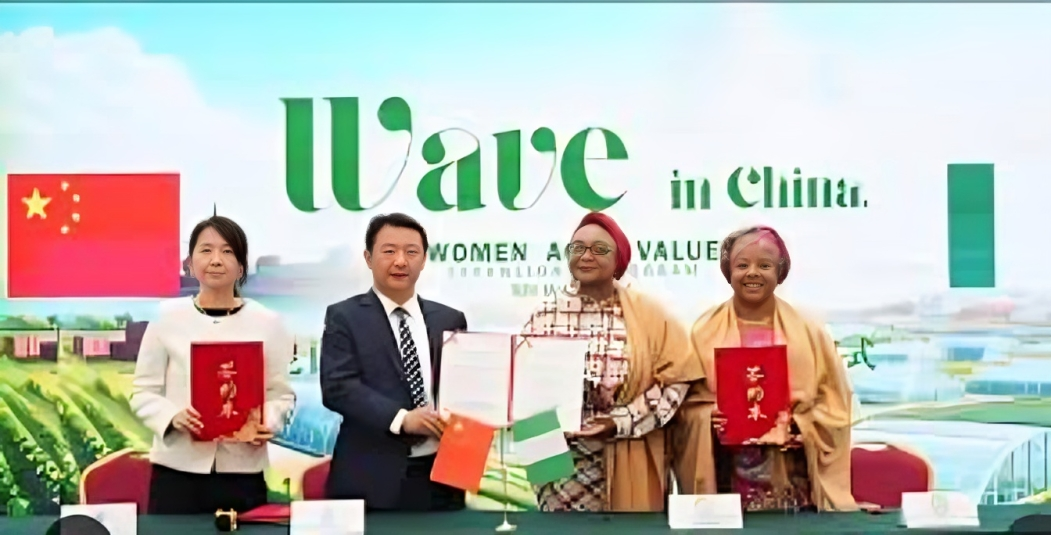
Given that women make up nearly 70% of Nigeria’s smallholder farmers, the Minister emphasized the importance of removing barriers such as inadequate financing, limited access to equipment, and insufficient training. To address these challenges, Nigeria signed a Memorandum of Understanding (MoU) with the Mutual Commitment Group (MCG), a Chinese enterprise dedicated to inclusive infrastructure and agricultural innovation.
“This strategic partnership will provide Nigerian women with the essential equipment, capacity-building, and resources they need to thrive in agriculture,” she noted.
The Minister also acknowledged the commitment of the Chairman of the House of Representatives Committee on Women Affairs, describing her support as “a true demonstration of dedication to the advancement of Nigerian women.”
The Nigerian delegation also held a trilateral dialogue at Jilin Agricultural University, focusing on agricultural science, education, and technology transfer. The talks explored sustainable methods to deepen collaboration in human capacity building and food security.
Enjoying this article? Share it with your network!
Jilin University shared insights from its “Science and Technology Yard” initiative in Zambia, which directly connects agricultural education with community development.
“We explored innovative pathways to strengthen Nigeria–China agricultural collaboration through human capacity building, technology transfer, and enhanced food security,” Sulaiman-Ibrahim said.
A joint proposal was introduced under the Four-Floor Agenda for Women, focusing on training programs, research cooperation, and innovation across the agricultural value chain.
In Changchun, the delegation also visited the Dikeng Medical Centre, where the Minister reiterated the need for community-focused healthcare systems.
“This experience reaffirmed our belief that community-centric care is the foundation of national wellbeing,” she explained.
Another Memorandum of Understanding was signed with the Mutual Commitment Company to establish Safe Spaces and Referral Services in all 774 local government areas across Nigeria, in addition to Mega Modern Sexual Assault Referral Centres (SARC) in each of the six geopolitical zones.
“Protecting the health and wellbeing of women and children is our foremost priority. This represents a long-term investment in the nation’s health and security,” she affirmed.
She further emphasized the importance of universal access to protection and support services, highlighting that technical assistance will be rolled out nationwide.
The Minister reiterated that every initiative unveiled during her visit to China aligns seamlessly with the Renewed Hope Agenda’s overarching vision of placing women at the forefront of Nigeria’s economic and social transformation.
“From experiencing healing in China to fostering national healing in Nigeria—the work truly begins now,” she said.
Through strategic cross-border partnerships and investments in agriculture, social systems, and technology, Nigeria is translating policy into tangible progress—ensuring that women are not spectators in national prosperity but active leaders shaping it.